Introduction
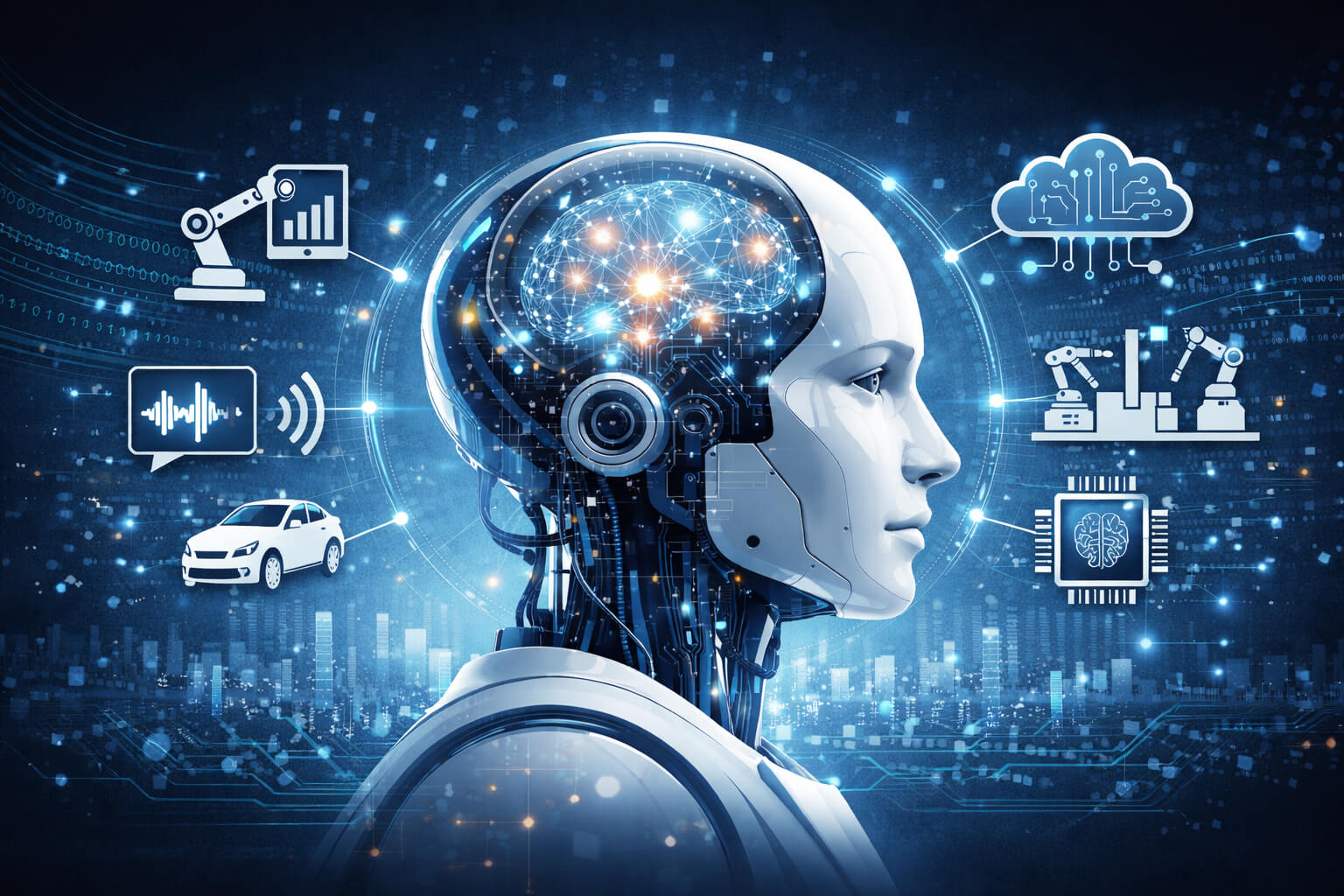
Artificial intelligence, often called AI, is no longer a futuristic concept reserved for science fiction. It is already part of everyday life, quietly powering the tools and services people use at work, at home, and online. From email spam filters and voice assistants to recommendation systems and automated software, AI helps computers perform tasks that once required human intelligence.
Despite its growing presence, AI is often misunderstood. Many people assume artificial intelligence is about robots replacing humans or machines becoming conscious. In reality, most AI systems today are practical, task-focused technologies designed to analyze data, recognize patterns, and make predictions.
This guide explains AI fundamentals in a simple, beginner-friendly way. You will learn what artificial intelligence is, how it works behind the scenes, and where it is used in real life—from automation to smart software.
What Is Artificial Intelligence?
Artificial intelligence is a branch of computer science focused on creating systems that can perform tasks normally requiring human intelligence. These tasks include learning from data, recognizing patterns, understanding language, making decisions, and solving problems.
Instead of following rigid instructions for every scenario, AI systems are designed to adapt based on information. They improve their performance by analyzing data and identifying relationships that may not be obvious to humans.
In simple terms, AI allows machines to:
- Learn from experience
- Recognize patterns
- Make predictions or decisions
- Improve over time without explicit reprogramming
AI does not mean a machine “thinking” like a human. Most AI systems are narrow in scope, meaning they are built to handle one specific task very well.
Types of Artificial Intelligence
Artificial intelligence can be grouped into three broad categories based on capability.
Narrow AI (Weak AI)
Narrow AI is the most common form of artificial intelligence today. It is designed to perform a single task or a limited set of tasks.
Examples include:
- Voice assistants
- Recommendation algorithms
- Image recognition systems
- Spam detection software
These systems do not understand context beyond their specific function.
General AI (Strong AI)
General AI refers to a theoretical form of AI that can perform any intellectual task a human can do. It would be capable of reasoning, learning across domains, and adapting to new situations independently.
General AI does not currently exist and remains a subject of research and debate.
Superintelligent AI
Superintelligent AI would surpass human intelligence in all areas, including creativity, decision-making, and emotional understanding. This concept is purely hypothetical and often discussed in ethical and philosophical contexts.
How Artificial Intelligence Works
At its core, artificial intelligence relies on data, algorithms, and computing power. While implementations vary, most AI systems follow a similar process.
Data Collection
AI systems require large amounts of data to learn effectively. This data can include text, images, numbers, audio, or video. The quality and relevance of data directly affect the system’s performance.
For example, an AI trained to recognize faces must analyze thousands or millions of images to identify patterns.
Algorithms and Models
Algorithms are mathematical instructions that tell the system how to process data. When combined with data, these algorithms create models that can recognize patterns or make predictions.
Machine learning models adjust internal parameters as they process more data, allowing them to improve accuracy over time.
Training and Testing
During training, the AI model analyzes data and learns relationships within it. Testing evaluates how well the model performs on new, unseen data. This step is critical to ensure the system works reliably outside its training environment.
Continuous Improvement
Many AI systems continue learning after deployment. Feedback loops allow them to refine predictions and adapt to new information.
Machine Learning and AI: What’s the Difference?
Machine learning is a subset of artificial intelligence. While AI is the broader concept, machine learning focuses on enabling systems to learn from data rather than follow fixed rules.
There are three common types of machine learning:
Supervised Learning
The system is trained using labeled data, where the correct output is known. This approach is often used for classification and prediction tasks.
Unsupervised Learning
The system analyzes unlabeled data to identify patterns or groupings. It is commonly used for clustering and anomaly detection.
Reinforcement Learning
The system learns through trial and error by receiving rewards or penalties based on its actions. This method is often used in robotics and game-playing AI.
Not all AI uses machine learning, but most modern AI applications rely on it heavily.
Real-World Uses of Artificial Intelligence
Artificial intelligence is already embedded in many industries and everyday applications.
Automation and Business Software
AI automates repetitive tasks such as data entry, customer support, and workflow management. Businesses use AI-powered tools to improve efficiency, reduce errors, and analyze large datasets quickly.
Smart Assistants and Voice Technology
Voice assistants use AI to recognize speech, understand intent, and respond naturally. These systems combine language processing, pattern recognition, and contextual analysis.
Healthcare and Medical Analysis
AI helps analyze medical images, predict disease risks, and assist in diagnostics. It supports healthcare professionals by identifying patterns that may be difficult to detect manually.
Finance and Fraud Detection
Banks and financial institutions use AI to monitor transactions, detect fraud, and assess credit risk. AI systems can identify unusual behavior in real time.
Software Development and Coding
AI tools assist developers by suggesting code, detecting bugs, and optimizing performance. This improves productivity while reducing development time.
Recommendation Systems
Streaming platforms, online stores, and news websites use AI to recommend content based on user behavior and preferences.
Benefits of Artificial Intelligence
Artificial intelligence offers several advantages when applied responsibly.
- Efficiency: Automates repetitive and time-consuming tasks
- Accuracy: Reduces human error in data-heavy processes
- Scalability: Handles large volumes of information quickly
- Consistency: Delivers reliable performance over time
- Insights: Identifies patterns humans may overlook
These benefits make AI especially valuable in complex systems and large-scale operations.
Limitations and Challenges of AI
Despite its strengths, artificial intelligence has important limitations.
Data Dependency
AI systems depend heavily on the data they are trained on. Biased or incomplete data can lead to inaccurate or unfair outcomes.
Lack of Understanding
AI does not truly understand meaning or context in the way humans do. It processes patterns rather than concepts.
Ethical and Privacy Concerns
The use of personal data raises concerns about privacy, transparency, and accountability. Responsible AI development requires clear ethical guidelines.
Limited Flexibility
Most AI systems cannot adapt beyond their specific training without significant redesign.
Is Artificial Intelligence Replacing Human Jobs?
AI is changing how work is done, but it is not simply replacing humans. In many cases, AI augments human capabilities rather than eliminating them.
Automation often handles repetitive tasks, allowing people to focus on creativity, strategy, and decision-making. New roles are also emerging around AI development, oversight, and integration.
The long-term impact of AI on jobs depends on how organizations adopt and manage the technology.
The Future of Artificial Intelligence
Artificial intelligence continues to evolve as computing power increases and research advances. Future developments are likely to focus on:
- More explainable and transparent AI systems
- Improved collaboration between humans and machines
- Stronger ethical standards and regulation
- Wider adoption across industries
Rather than a single breakthrough, AI’s future will likely be shaped by steady improvements and responsible implementation.
FAQs
What is artificial intelligence in simple terms?
Artificial intelligence is technology that allows machines to perform tasks that normally require human intelligence, such as learning, recognizing patterns, and making decisions.
Is AI the same as machine learning?
No. Machine learning is a subset of AI that focuses on learning from data. AI also includes rule-based systems and other approaches.
Where is AI used in daily life?
AI is used in voice assistants, recommendation systems, email filtering, navigation apps, and smart software tools.
Can AI think like a human?
Current AI cannot think or reason like a human. It processes data and patterns without consciousness or understanding.
Final Thoughts
Artificial intelligence is a powerful tool that continues to shape modern technology. By understanding AI fundamentals—what it is, how it works, and where it is used—you can make informed decisions about adopting and using AI responsibly.
Rather than replacing human intelligence, AI works best as a supportive system that enhances efficiency, insight, and innovation across industries.
Leave a Reply